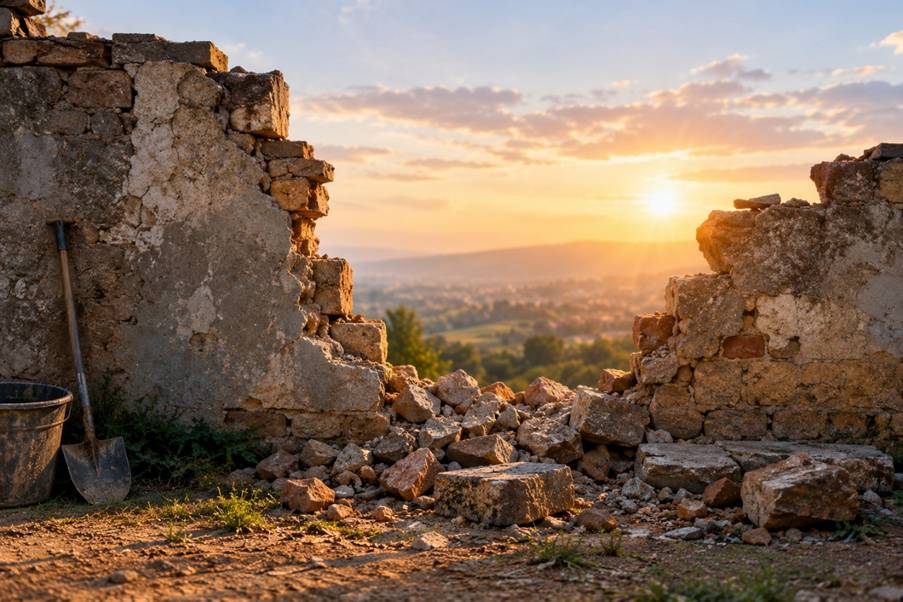
“The God of heaven will give us success. We, His servants, will start rebuilding.” Nehemiah 2:20
There are seasons in life when the assignment is not to build something entirely new, but to rebuild what has been broken, neglected, abandoned, or left unfinished.
For me, 2026 has become the year of re-building.
As our CLG journey moved from Esther into Nehemiah, I found myself seeing Scripture through a deeply personal lens. Esther taught us about courage, identity, purpose, and being positioned for such a time as this. Then came Nehemiah, a story about broken walls, burned gates, opposition, perseverance, prayer, leadership, and restoration.
Perhaps the transition was more prophetic than I initially realised.
Nehemiah did not arrive at an empty city. He arrived at a place with a history. Jerusalem had once been a flourishing city, but its walls had been broken down and its gates burned with fire. What stood before him was evidence of loss, vulnerability, and unfinished work.
Yet Nehemiah did not look at the ruins and conclude that the story was over.
He saw something that could be rebuilt.
And perhaps that is what God has been teaching me this year.
Rebuilding does not mean starting over
Sometimes we hear the phrase “start over” and assume that everything that came before was wasted.
I have come to realise that rebuilding is different.
Rebuilding means taking what remains and allowing God to restore, strengthen, rearrange, and give new meaning to it.
It means acknowledging what was broken without allowing brokenness to become our identity.
It means looking at the ruins and saying, This is not the end of the story.
Psychologically, rebuilding is also part of human resilience. Life inevitably brings disruption, loss, disappointment, transitions, relational wounds, career changes, unanswered questions, and shattered expectations. Healing does not necessarily mean returning to who we were before the disruption. Sometimes healing involves constructing a new way of living from what we have learned.
We rebuild with greater awareness.
We rebuild with boundaries.
We rebuild with wisdom.
We rebuild with God.
Rebuilding my faith
One of the most significant areas of rebuilding for me has been my relationship with God.
There have been seasons when faith felt strong and seasons when it felt distant. There have been seasons of prayer, seasons of silence, seasons of questioning, and seasons when I simply had to return.
But rebuilding faith has taught me something important:
Faith is not merely about maintaining spiritual routines. It is about rebuilding relationship.
Prayer and fasting have become part of this rebuilding process.
There is something about intentionally slowing down, becoming quiet before God, surrendering control, and allowing Him to search the deeper places of the heart.
Sometimes the greatest rebuilding happens where nobody else can see.
Before God rebuilds the walls around us, He often begins by rebuilding the foundations within us.
Rebuilding through prayer and fasting
Nehemiah’s response to the news about Jerusalem was prayer.
Before he strategised, he prayed.
Before he approached the king, he prayed.
Before the rebuilding began, he sought God.
That order has challenged me.
In a world that encourages immediate action, productivity, networking, planning, and problem solving, prayer reminds me that not everything should begin with activity.
Some things must begin with surrender.
Prayer has become less about telling God what I want Him to do and more about allowing Him to reshape what I want.
Fasting, too, has become part of that process.
There are things we cannot rebuild through human strength alone.
Some walls require prayer.
Some doors require obedience.
Some dreams require patience.
And some seasons require us to simply wait for God.
Remember, your ruins do not have to be your final story!


Leave a Reply