By Elicipha Njuguna
Sometimes, the very strength that helps us survive can become the thing that prevents us from healing.
The paradox of strength is that what makes us resilient can also make us vulnerable.
A person who has learned to survive difficult circumstances may become exceptionally independent. They learn not to ask for help, not to complain, not to depend on others, and to keep moving regardless of how exhausted they are.
That strength may have been necessary once.
But what protected them then may limit them now.
When strength becomes a shield
Psychologically, resilience is valuable. It helps people adapt, recover, and continue functioning in the face of adversity.
But there is a difference between resilience and emotional invulnerability.
Sometimes we say:
“I can handle it.”
“I don’t need anyone.”
“I have survived worse.”
“I’ll be fine.”
And perhaps we will.
But constantly being the strong one can make it difficult to admit:
“I am tired.”
“I need help.”
“That hurt me.”
“I don’t know what to do.”
The paradox is that the person who has become very good at carrying others may have forgotten what it feels like to be carried.
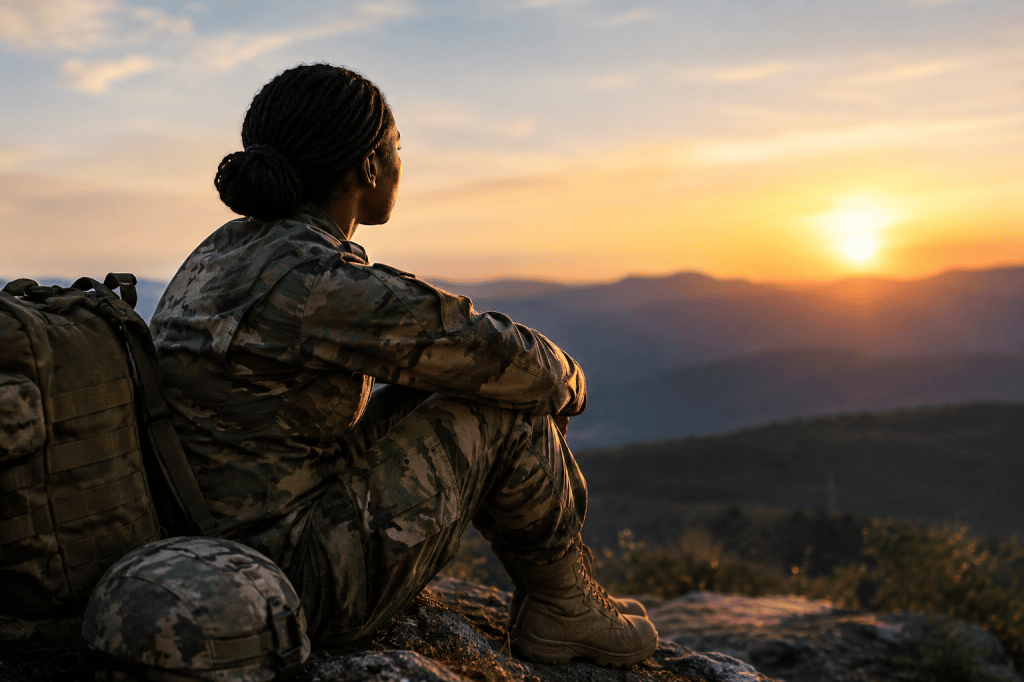
The strong soldier still needs rest
Military training provides a powerful metaphor.
A soldier is trained to endure discomfort, remain alert, follow through under pressure, and continue despite difficult conditions.
But even the strongest soldier needs rest, nourishment, medical attention, recovery and a team.
No responsible military system expects a soldier to operate indefinitely without replenishment.
Why do we sometimes expect that from ourselves?
We celebrate the person who keeps going but rarely ask what the constant going is costing them.
Endurance without recovery eventually becomes depletion.
Even faith can be misunderstood
Sometimes, particularly within Christian communities, strength can become confused with never struggling.
We may believe that because we trust God, we should not feel overwhelmed.
But Scripture is filled with people who were faithful and exhausted.
David cried.
Elijah became overwhelmed.
Jesus wept.
Paul acknowledged weakness.
Faith does not require us to pretend that we are unaffected by life.
Paul writes:
“My grace is sufficient for you, for my power is made perfect in weakness.” 2 Corinthians 12:9
Perhaps weakness is not always the opposite of strength.
Sometimes acknowledging weakness is an expression of strength.
What if you don’t always have to be strong?
Maybe strength is not always about carrying more.
Sometimes strength is knowing when to put something down.
Strength is setting a boundary.
Strength is asking for help.
Strength is admitting that something hurt.
Strength is allowing yourself to rest without feeling guilty.
Strength is receiving rather than always giving.
Strength is saying, “I cannot do this alone.”
And perhaps the deepest paradox is this:
You do not become weaker when you allow yourself to be supported.
You become more human.
Reflection
What strength helped me survive a previous season but may now be preventing me from receiving help, expressing vulnerability, resting, or healing?
Because sometimes the next stage of growth does not require us to become stronger, it requires us to feel safe enough to put the armour down.


Leave a Reply