By Elicipha Njuguna
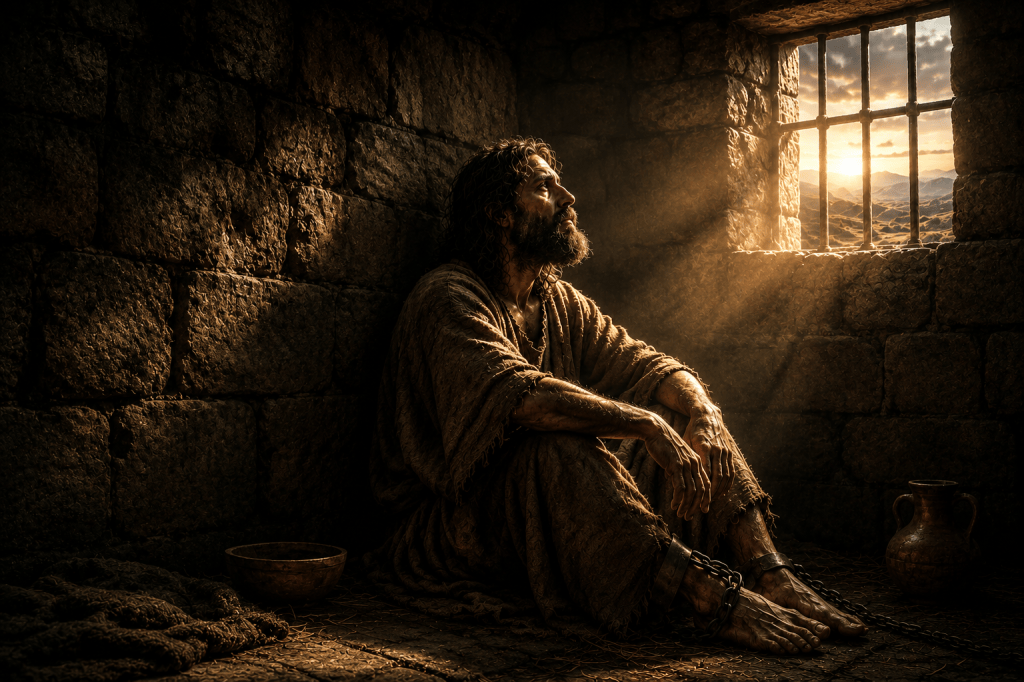
We often talk about the mountaintop experiences of faith, those moments when prayers seem to be answered instantly, the road ahead feels clear, and God’s voice feels unmistakable.
But what happens when the thunder stops?
What happens when you are praying, obeying, serving faithfully, and yet heaven feels silent? What happens when you are doing everything you know to do, but the heavens feel like brass?
Few stories in Scripture capture this painful tension more vividly than the story of John the Baptist.
We know John as the bold forerunner of Christ, the voice crying in the wilderness, the prophet who prepared the way for the Messiah, the man who baptized Jesus Himself. He was fearless, uncompromising, and deeply rooted in purpose.
Yet there is a chapter of his life we often rush past: the end.
The Resume of a Faithful Servant
If anyone appeared deserving of divine intervention, it was John.
• He was chosen. His life carried prophetic significance even before birth, to prepare the way for the Messiah.
• He was family. He shared blood ties with Jesus.
• He was faithful. John did not land in prison because of compromise, failure, or disobedience. He was imprisoned because he courageously confronted sin and spoke truth to power.
John did everything right.
And his reward?
A dark prison cell.
The wilderness preacher who once lived under open skies now sat confined behind cold stone walls.
The Deafening Silence
While John remained in prison, reports began to reach him.
Jesus was traveling through Galilee.
The blind were seeing.
The lame were walking.
Lepers were being cleansed.
The dead were being raised.
Miracles were happening everywhere.
But not for John.
No rescue.
No prison doors opening.
No angelic intervention.
Only silence.
Psychologically, prolonged suffering combined with unanswered expectations can create intense cognitive dissonance, the distress that occurs when lived reality clashes with deeply held beliefs.
John likely believed something like this:
If Jesus truly is the Messiah, then surely justice will come. Surely deliverance will follow faithfulness.
But his lived experience told a different story.
And when belief collides with reality, the human mind naturally begins searching for explanations.
This search can become emotionally exhausting.
When no answers come, we often fill the silence with painful assumptions:
Did I misunderstand God?
Did I fail somehow?
Has God forgotten me?
Was my faith misplaced?
These are not merely theological questions.
They are deeply human ones.
Eventually, John asks the question many faithful people whisper in seasons of suffering:
“Did I get this wrong?”
In Matthew 11:3, John sends his disciples to Jesus with a heartbreaking question:
“Are you the one who is to come, or should we expect someone else?”
This was not rebellion.
It was anguish.
It was the cry of a faithful heart struggling under the weight of pain.
From a psychological perspective, John’s question reminds us of something important: doubt is not always the opposite of faith; sometimes it is faith wrestling with pain.
People walking through grief, depression, trauma, or chronic suffering often do not lose faith first.
They lose certainty.
And prison has a way of stripping certainty.
What Silence Is Not
If you are currently in a season of silence, John’s story offers profound hope.
It teaches us what God’s silence does not mean.
1. Silence Is Not Absence
Jesus did not rebuke John for asking hard questions.
Instead, He responded by pointing to evidence of the Kingdom:
The blind see.
The lame walk.
The poor hear good news.
In essence, Jesus was saying:
I am still working, even if not in the way you expected.
One of the deepest human fears is abandonment.
Psychologically, silence can easily trigger this fear because our nervous systems often interpret lack of response as lack of care.
But silence is not proof of absence.
God’s apparent quietness does not mean inactivity.
Sometimes we struggle to recognize divine movement because we measure God’s presence only by visible breakthroughs or immediate relief.
Yet God may still be working, in unseen ways, around us, within us, or through circumstances we cannot yet understand.
2. Silence Is Not Disapproval
Suffering often breeds shame.
When prayers remain unanswered, it becomes easy to assume:
Maybe God is disappointed in me.
Maybe I am being punished.
Maybe I failed spiritually.
But after John’s disciples left, Jesus turned to the crowd and declared:
“Truly I tell you, among those born of women there has not risen anyone greater than John the Baptist.”
Matthew 11:11
Notice the irony.
At the very moment John felt forgotten, Jesus was honoring him.
At the very moment John questioned, Jesus was affirming him.
This mirrors a crucial psychological truth: our emotional experience is not always an accurate reflection of reality.
Depression may tell us we are abandoned.
Shame may tell us we are unworthy.
Fear may tell us we are alone.
Feelings are real and important.
But they are not always reliable narrators.
You can feel forgotten and still be deeply loved.
You can feel weak and still be honored by God.
You can be faithful and still struggle.
You can be beloved and still be in the dungeon.
3. Even in Silence, Suffering Can Become a Place Where Deeper Trust Is Formed
Jesus ended His message to John with these words:
“Blessed is anyone who does not stumble on account of me.”
These words are both tender and challenging.
Jesus was inviting John into a deeper kind of faith, one rooted not in expected outcomes, but in God’s character.
This does not mean God caused John’s suffering in order to teach him a lesson.
Not all suffering is divinely orchestrated as a training exercise.
We live in a broken world shaped by human sin, injustice, and pain.
Yet even within suffering, God can bring forth something profound.
He can form trust.
Psychology refers to this as distress tolerance, the capacity to remain grounded amid pain without collapsing into despair or making premature conclusions.
Faith deepens this further.
It says:
Even when I do not understand what God is doing, I can still anchor myself in who God is.
Sometimes deeper trust is not formed because suffering is good.
It is formed because God remains good even in suffering.
Jesus was asking John to trust His heart, even when John could not see His hand.
The Hard Truth
We want this story to end differently.
We want an earthquake like the one that freed Paul and Silas.
We want chains to break.
We want prison doors to open.
We want miraculous rescue.
But John’s story ended with an executioner.
That is difficult to accept.
It confronts one of the hardest truths of faith:
Following God does not guarantee comfort, immediate rescue, or freedom from suffering.
Faith is not a contract promising a pain-free life.
It is a relationship with a God whose purposes often extend far beyond our present understanding.
John once said of Jesus:
“He must increase, but I must decrease.”
Even in death, John continued pointing beyond himself.
His life testified that the Kingdom of God transcends earthly outcomes, even death itself.
To You, in the Waiting
Perhaps your prison does not have stone walls.
Perhaps it is:
• a prison of sickness
• a prison of grief
• a prison of depression
• a prison of unemployment
• a prison of loss
• a prison of unanswered prayers
If God feels silent, John’s story reminds you that you are not alone.
Silence is painful.
Silence is confusing.
Silence can stir fear, doubt, and emotional exhaustion.
But silence is not abandonment.
God has not forgotten you.
His quietness is not necessarily His anger.
Even when you cannot perceive Him, He remains present.
He may be weaving redemption in ways too vast to understand from inside your current suffering.
The voice that once cried out in the wilderness is now singing in eternity.
And the God who seemed silent was never absent.
He was present all along.
We all encounter seasons of wilderness, and they can feel profoundly lonely.
In what area of your life have you experienced God’s silence?
And in that waiting, what truth helped you endure?
 Site Title
Leave a comment