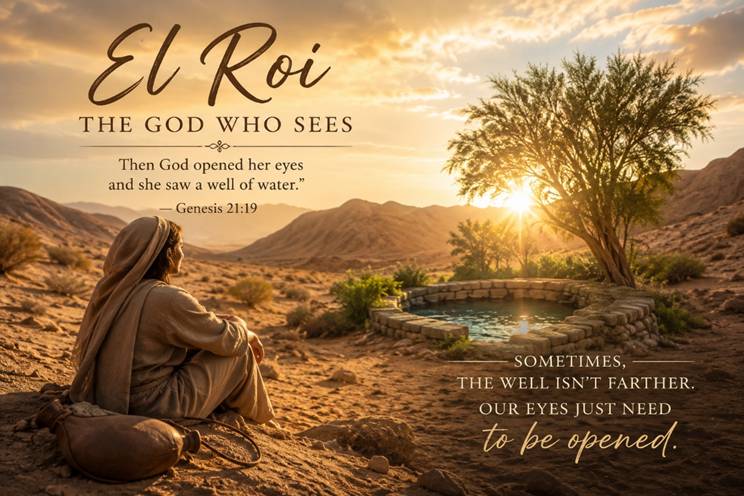
You can die of thirst beside a well. Sometimes the deepest tragedy is not living in a desert, but becoming so consumed by pain that you can no longer see the provision sitting beside you.
The desert does not merely parch the throat; it reshapes the way we see.
Under the blinding glare of a noon-day sun and the endless stretch of shifting sands, the horizon ceases to be a geographic boundary and becomes a psychological burden. In barren places, perception itself changes. Survival takes over. Vision narrows. Fear grows louder than possibility.
Scripture captures this reality vividly in the story of Hagar and her son Ishmael in the wilderness of Beersheba.
Sent away by Abraham and deeply wounded by Sarah’s rejection, Hagar walked into the wilderness carrying a finite supply of bread and a single skin of water. When the water ran out, her world collapsed into one agonizing certainty: death seemed inevitable. She placed her son under a bush and sat a bowshot away because she could not bear to watch him die.
Then Genesis records a striking detail:
“Then God opened her eyes and she saw a well of water” (Genesis 21:19).
Notice the sequence carefully.
God did not create a well at that moment. He did not split open the earth or send sudden rain from the sky. The well already existed. Provision was already present. Hagar had simply been unable to see it.
Her miracle was not the creation of a resource.
Her miracle was restored vision.
The Blindness of the Desert Experience
Hagar’s blindness was not physical; it was emotional, psychological, and spiritual.
Imagine her internal world: rejection from the only household she had known, uncertainty about her future, fear for her child, and the sting of being unwanted. Her thoughts were likely consumed by grief, confusion, abandonment, and despair.
Psychology tells us that pain often narrows our attention. Under distress, the mind becomes preoccupied with immediate threats and losses. We naturally begin focusing on what is missing, what has ended, and what feels unsafe.
Hagar stared at the empty water skin.
She counted what had run out.
She focused on what she feared losing.
Because her internal landscape had become a wilderness, her external world began to appear barren as well.
Many of us know this experience.
After rejection, we sometimes see only abandonment.
After loss, we sometimes see only emptiness.
After disappointment, we sometimes see only closed doors.
Pain can become a lens through which everything else is interpreted.
The Psychology Behind Missing the Oasis
Modern psychology gives language to what Hagar experienced thousands of years ago.
Our minds do not passively record reality like cameras. Instead, they filter information according to what feels important, threatening, or emotionally significant.
Researchers refer to this as selective attention. When our minds become consumed by heartbreak, betrayal, anxiety, or fear, we unintentionally overlook other realities around us.
If our inner narrative becomes:
“I have been abandoned.”
“Nothing is working.”
“I have lost everything.”
Then our minds often begin collecting evidence that confirms those conclusions.
The opportunities, relationships, and resources around us can fade into the background, not because they do not exist, but because our pain has captured our attention.
Stress Creates Tunnel Vision
When human beings perceive danger, our brains narrow attention toward the threat.
This response is protective. It helps us survive emergencies. But when emotional distress persists, tunnel vision can become limiting.
Hagar saw the empty water skin.
She saw her dying child.
She saw her fear.
What she could not yet see was the well nearby.
Many of us do the same.
We become so focused on what we have lost that we no longer notice what remains.
Unresolved Bitterness Can Shape Perception
Bitterness is understandable. Wounds deserve acknowledgement.
But bitterness can gradually become more than pain; it can become a lens.
When we remain consumed by resentment, our emotional energy often becomes directed toward the person who hurt us, the opportunity we lost, or the injustice we experienced. We repeatedly revisit the injury until it begins occupying more space than our future.
Bitterness does not only keep us connected to our pain.
Sometimes it keeps us from seeing our provision.
El Roi: The God Who Sees
This is where the beauty of God’s character enters the story.
Hagar had previously encountered God and called Him El Roi “The God Who Sees Me.”
She discovered that even in isolation and suffering, she was not invisible.
Yet in Genesis 21, the issue is not whether God sees Hagar.
The issue is whether Hagar can see what God has already provided.
God’s intervention is subtle but profound:
“God opened her eyes.”
Often, we pray:
“Lord, change my circumstances.”
“Take me out of this wilderness.”
“Create a miracle.”
Sometimes God certainly does alter circumstances dramatically.
But often His work begins somewhere deeper.
He changes our vision.
He gently redirects our attention away from empty water skins and toward hidden wells.
He helps us notice grace that was present all along.
The God who sees us also helps us see.
Practices for Unclouding Your Vision
If you find yourself in a personal desert today, Hagar’s story offers both psychological wisdom and spiritual invitation.
- Acknowledge reality without allowing it to define reality.
The empty water skin mattered. It was real. But it was not the entire landscape.
Loss deserves honesty, but loss does not tell the whole story.
- Examine what occupies your emotional attention.
Ask yourself:
“What am I staring at repeatedly?”
“What story am I replaying?”
“What pain has become my only reference point?”
Awareness creates room for new perspective.
- Pray for opened eyes, not only changed circumstances.
Perhaps one of the most courageous prayers we can pray is:
“El Roi, open my eyes.”
Help me see the relationships I still have.
Help me see the strength I still carry.
Help me see the opportunities, the grace, and the wells I have overlooked.
The Well Was Already There
Perhaps the deepest tragedy is not living in a desert.
Perhaps it is dying beside a well we never noticed.
Your oasis may not be a distant miracle waiting somewhere in the future. Sometimes the resources for healing, growth, restoration, and renewal are already within reach.
The supportive friend.
The opportunity you dismissed.
The resilience God quietly planted in you.
The grace that has been sustaining you all along.
Do not allow the pain of rejection to become the final authority over your vision.
Step back from the empty water skin.
Quiet the echoes of old wounds.
Lift your eyes.
El Roi still opens them.
And perhaps, closer than you realize, the well is already there.


Leave a comment