By Elicipha Njuguna
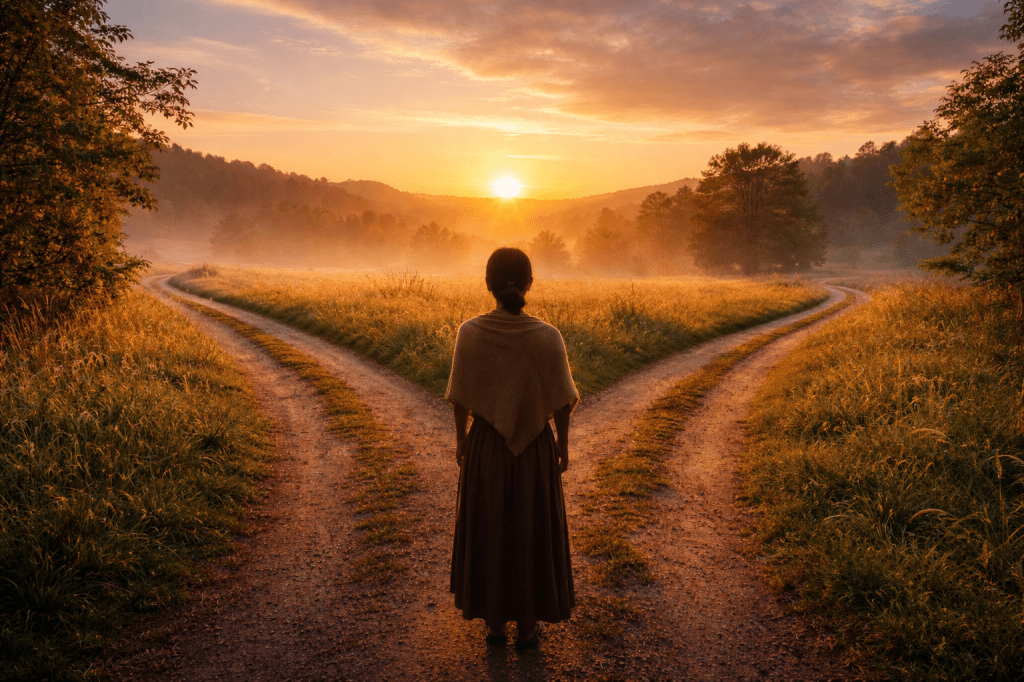
In the opening chapter of the Book of Ruth, we encounter three women standing at both a physical and spiritual crossroads. Naomi, carrying the weight of loss, begins her journey back to Bethlehem. Beside her stand her two daughters in law, Orpah and Ruth, pausing between what has been and what could be.
At first glance, the story seems simple. One leaves. One stays. One disappears. One is remembered.
But beneath that simplicity lies a deeper question that reaches into our own lives: not just who we are, but what we choose.
The Path That Makes Sense
Orpah’s decision is often overlooked, yet it deserves careful attention.
She had lost her husband. Her future was uncertain. Naomi, in a moment of honesty, urged her to return home and rebuild her life. And she did.
Her choice was grounded:
• It was wise. She chose stability in a time of uncertainty.
• It was respectful. She listened and responded to Naomi’s counsel.
• It was familiar. She returned to what she understood, her people, her culture, her way of life.
There is nothing inherently wrong with her decision. It was thoughtful, reasonable, and safe.
And yet, her story quietly ends there.
The Path That Requires Surrender
Ruth stood in the same moment, with the same losses and the same unknown future, and chose differently.
Her decision was not driven by certainty, but by conviction.
She chose to go with Naomi into a land where she would be an outsider. As a Moabite, she carried a history that could have defined and limited her. Yet she did not allow that identity to determine her direction.
Her choice reveals something deeper:
• It was costly. There were no guarantees of provision or acceptance.
• It was spiritual. She aligned herself with Naomi’s God, not just Naomi’s journey.
• It was transformative. She released what had defined her and stepped into what she could not yet see.
Ruth did not simply change location. She changed direction.
The Mirror: What Are You Choosing?
In the first reflection on this story, we considered the identities we carry and the ones we place on others. Here, the question shifts slightly.
What we believe about ourselves shapes what we choose.
If we see ourselves through limitation, we will choose what is safe. If we begin to see ourselves through possibility, we become open to what requires trust.
Orpah chose what made sense. Ruth chose what aligned with a deeper calling.
Both choices were real. But only one moved her into the unfolding story God was writing.
When Comfort Becomes a Boundary
The challenge with what is familiar is not that it is wrong, but that it can quietly confine us.
What feels stable can become restrictive. What feels safe can prevent growth. Over time, we may find ourselves settled in places that no longer stretch us.
For Ruth to step into her future, she could not remain where she was. She had to leave behind what was known in order to walk into what was possible.
In time, that decision placed her in a lineage far greater than she could have imagined, becoming part of the family line that would lead to Jesus Christ.
A Personal Crossroads
Each of us encounters moments like this. Moments where the logical path is clear, yet something deeper invites a different response.
These moments rarely announce themselves loudly. They often appear in quiet decisions:
To stay or to step forward.
To hold on or to release.
To choose comfort or to embrace calling.
A Moment of Reflection
Consider these questions:
- Where in your life are you choosing what feels safe rather than what is being asked of you?
- What familiar place are you holding onto, even though you sense it may be limiting your growth?
- What step, though uncertain, feels aligned with a deeper sense of purpose?
A Gentle Challenge
This week, identify one area where you have been leaning toward what is predictable. Write it down.
Then ask yourself: what would the Ruth response look like here?
Closing Thought
Orpah chose what was reasonable and returned to what she knew; Ruth chose what was calling and stepped into what she could not see. And in that surrender, God began to write a legacy that comfort could never produce.


Leave a comment