By Elicipha Njuguna

The story of Jacob is one of the most honest, hope-filled narratives in Scripture, a mirror of human brokenness and divine patience. It reminds us that God does not abandon us in our flawed patterns, but faithfully works within them to bring about transformation.
Jacob’s story begins with symbolism. Born grasping the heel of his older twin, Esau, he is given a name that means supplanter or deceiver. From the very beginning, Jacob’s life is marked by striving, reaching for what is not his, grasping for advantage, attempting to secure blessing through manipulation rather than trust.
As he grows, the pattern intensifies. Jacob exploits his brother’s hunger, persuading Esau to trade his birthright for a bowl of lentil stew. Later, with his mother Rebekah’s help, he deceives his blind father Isaac and steals the blessing meant for Esau. The victory is hollow. The cost is immediate: fear, guilt, and exile. Jacob runs for his life.
What Jacob does not yet understand is this truth: you may outrun people, but you cannot outrun formation.
In Haran, Jacob meets his match in his uncle Laban, a master deceiver. There, Jacob tastes the bitterness of his own ways. He is tricked into marrying Leah instead of Rachel, then forced to work fourteen years for the woman he loves. Even after that, Laban repeatedly changes Jacob’s wages, exploiting his labor and ambition.
This becomes the great turning point of Jacob’s story. What he once used on others is now used on him. Deception becomes his teacher. Pain becomes his mirror. God allows Jacob to experience the weight of his own patterns, not to punish him, but to mature him.
Years later, as Jacob prepares to return home and face the brother he once betrayed, he encounters God in the wilderness. Alone, fearful, and vulnerable, Jacob wrestles through the night with a mysterious divine figure. He refuses to let go without a blessing, but this time, something is different. He is no longer grasping in secret. He is clinging in surrender.
God gives Jacob a new name: Israel meaning one who wrestles with God. His identity shifts. No longer defined by deception, he is now marked by encounter. He limps away from that place changed, physically weakened, but spiritually transformed. The limp becomes a reminder: transformation often costs us our illusions of strength.
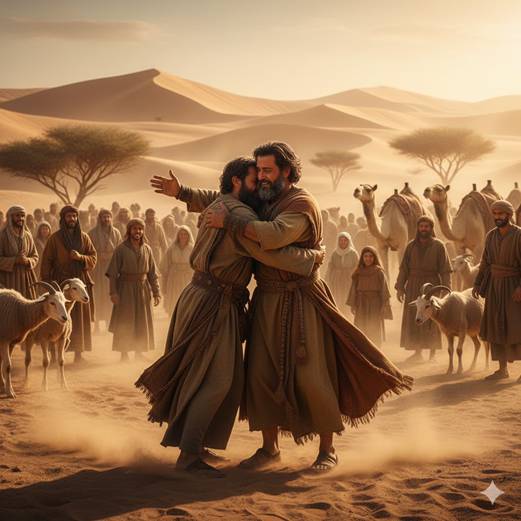
When Jacob finally meets Esau again, the outcome is nothing like he feared. Esau runs to meet him, embraces him, and receives him with grace. The story that began with rivalry ends in reconciliation. The one who once stole a blessing now discovers that true blessing comes through humility, repentance, and God’s grace.
The Greater Redemption in Jacob’s Story
Perhaps the most astonishing truth of Jacob’s life is this: God chose this flawed, deceptive, wrestling man to be part of the lineage through which the Savior of the world would come. From Jacob (renamed Israel) would emerge the twelve tribes. And from this line, generations later, would come Jesus Christ.
This is not incidental. It is revelatory.
God did not wait for a perfect man to advance His redemptive plan. He worked through a transformed one. Jacob’s story declares that redemption is not about moral perfection, but about surrendered hearts. The God who renamed Jacob is the same God who brings salvation to humanity; turning broken stories into vessels of grace.
Jacob’s life testifies that God’s purposes are greater than our past, and His grace runs deeper than our failures.
What Jacob’s Story Teaches Us
- God is not intimidated by our flaws or our past.
- Repeated patterns persist until we allow God to confront and transform them.
- Healing often comes through surrender, not control.
- Encounter with God precedes reconciliation with others.
- God weaves personal transformation into His larger redemptive story.
Jacob’s life reminds us that transformation is a process. God is faithful to complete the work He begins, even when it takes years, wilderness seasons, and uncomfortable mirrors.
A Reflective Invitation
Where in your life are you still grasping; trying to secure love, approval, success, or blessing through control rather than trust?
What patterns keep repeating because they have not yet been surrendered?
This week, take time to sit honestly before God and ask:
- What is my name right now?
- What needs to change for me to step into the person You are forming me to be?
Like Jacob, may you have the courage to wrestle, the humility to surrender, and the faith to believe that God can still rename your story, and use it for His redemptive purposes.


 Site Title
Leave a reply to Elicipha Njuguna Cancel reply