By Elicipha Njuguna

In the modern church, we are often experts at the “gather.” We know how to market events, fill seats, and create engaging services. But Mike Breen, in his seminal book Building a Discipling Culture (2011), asks a haunting question: Are we making converts, or are we making disciples?
Breen argues that many churches have prioritized numerical growth over Christ’s actual mandate in Matthew 28:18–20. The result is a widening gap between church attendance and deep, spiritual transformation.
Culture Always Outperforms Strategy
The core premise of Breen’s work is simple yet profound: Culture eats strategy for breakfast. You can have the best discipleship “program” in the world, but if the culture of your community doesn’t expect every believer to be a disciple-maker, the program will eventually fail.
A true discipling culture moves away from “information transfer” (classroom learning) and toward “identity formation” (life-on-life imitation). Crucially, this applies whether you are in the church, leading your family, or navigating corporate workspaces. Discipleship is not a religious hobby; it is a portable lifestyle.
The Frameworks of a Movement
To help leaders shift from programs to culture, Breen introduces “LifeShapes”—visual tools that make complex theology easy to remember and reproduce in any environment.
1. The Discipleship Square (Up, In, Out, With)
Discipleship isn’t one-dimensional. To be healthy, a disciple must balance four directions:
- UP: Intimacy with God (Prayer, Scripture, Worship).
- IN: Authentic community and hospitality with other believers.
- OUT: Mission and engagement with the world.
- WITH: Intentional relationships where accountability happens.
The Danger: If you are “Up” but not “Out,” you become inward-focused. If you are “Out” but not “In,” you face rapid burnout. This balance is just as vital for a CEO as it is for a parent.
2. The Learning Circle
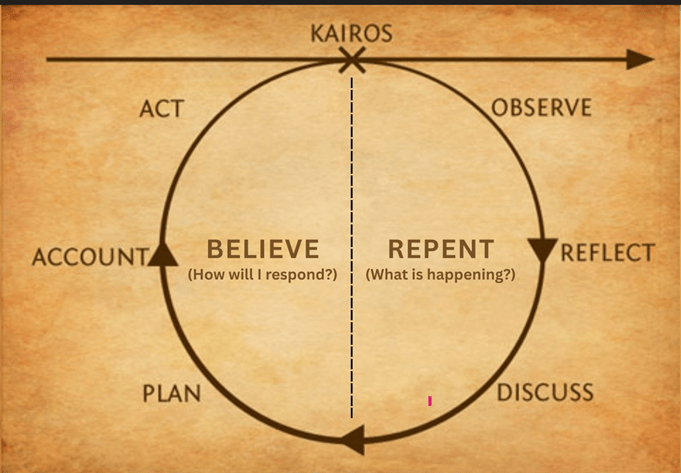
Spiritual maturity isn’t about how much you know; it’s about how much you obey. The Learning Circle moves disciples through a five-step cycle: Observe, Reflect, Discuss, Plan, and Do. Whether you are processing a sermon, a parenting struggle, or a failed business project, the question remains: What is God saying to me, and what am I going to do about it?
3. Spiritual Parenting
We must stop treating every believer as if they are at the same stage. Breen’s model identifies four stages: Infancy, Childhood, Young Adulthood, and Parenthood. The goal is to move people toward “Spiritual Parenthood,” where they are capable of reproducing and raising new disciples themselves—at home, at work, and in the pews.
Bringing it Home: Practical Application
How do we move these theories into the practical rhythms of our lives?
- In the Church: Implement the Learning Circle in Small Groups. Instead of just “studying” a text, ask: What is God saying to you? and What are you going to do about it?
- In the Family: Use “Spiritual Parenting” to guide your children. Move beyond enforcing rules to shaping their identity. Use the “Triangle” (Up, In, Out) to ensure your family isn’t just living for its own comfort, but is on mission together.
- In the Workplace: Conduct a “Spiritual Audit” of your leadership. Are you leaning too heavily into “Out” (productivity) while neglecting “Up” (seeking wisdom) or “In” (caring for your team)? Use the Learning Circle to turn professional setbacks into moments of character growth.
The Application Challenge
How will you specifically apply the Learning Circle this week in your workplace, in your parenting, or within your Huddle?
Call to Action: Start Your First “Circle” Today
Culture doesn’t change through a memo; it changes through a Kairos moment—an event in your daily life where God is trying to get your attention.
This week, identify one “Kairos” moment in your life—a conflict at the office, a breakthrough with your child, or a stirring during prayer—and run it through the Learning Circle:
- Observe: What happened?
- Reflect: Why did it happen? What was I feeling?
- Discuss: Tell one trusted person (a spouse, a mentor, or a peer) what you’re sensing.
- Plan: What is one small, concrete step you can take in the next 48 hours to respond?
- Account: Ask that person to check in with you on Friday to see if you did it.
Stop measuring your spiritual life by the seat you fill on Sunday, and start measuring it by the steps you take on Monday.


 Site Title
Leave a reply to Elicipha Njuguna Cancel reply