
It’s a classic irony of the human condition: We are social creatures who crave connection, yet the idea of standing before our peers to speak is, for many, more terrifying than the thought of death itself.
In the clinical world, we call it Glossophobia. In the real world, we call it “the reason I didn’t raise my hand in class” or “why I turned down that promotion.” It is also better known as the “I’d rather be in the casket than giving the eulogy” syndrome.
As a psychologist, I’ve spent years studying the mechanics of anxiety. But if I’m being honest, my greatest lessons didn’t come from a textbook; they came from the pounding of my own heart every time I was forced into the limelight.
The Professional Who Preferred the Background
By nature, I am a background person. This isn’t a trait I picked up in adulthood; I have been deeply shy since childhood. Back then, I would go to great lengths to avoid interacting with new people, preferring the safety of the familiar and the quiet of my own thoughts.
This aversion to attention wasn’t limited to the stage; it permeated the visual aspects of my life as well. Even today, I find the act of posing for a photograph deeply uncomfortable. There is a specific kind of vulnerability in being the focal point of a lens—the pressure to “perform” a smile or a posture while knowing you are being recorded and judged. To me, a camera felt like just another spotlight I hadn’t asked for. I would find myself overthinking my expression, wondering where to put my hands, and ultimately feeling like an imposter in my own skin.
As I entered my career, that shyness evolved into a sophisticated system of avoidance. For a long time, I built my life around staying invisible. I dodged responsibilities that would throw me into the limelight and successfully stayed under the radar.
But avoidance is a greedy master; the more you give it, the more it takes. Eventually, my world felt small. I realized that to help others find their voices, I had to stop silencing my own, even if it meant confronting a shyness I had carried since I was a child.
Understanding the Fear
Glossophobia consistently ranks as one of the top fears globally, affecting approximately 75% of the general population. From an evolutionary perspective, this makes sense. To our ancestors, being the center of attention meant you were being judged by the “tribe.” If the tribe rejected you, your survival was at stake. Today, our nervous systems still experience that fight-or-flight surge as if a predator or a camera lens is staring us down.
The Path Forward
If you are struggling, please know that bravery isn’t the absence of fear; it’s the decision that something else is more important. My journey wasn’t a “magic switch” moment, it was a process of Systematic Desensitization.
This involves gradually exposing yourself to the feared stimulus while practicing relaxation techniques. You are teaching your amygdala that you are safe, even when eyes are on you.
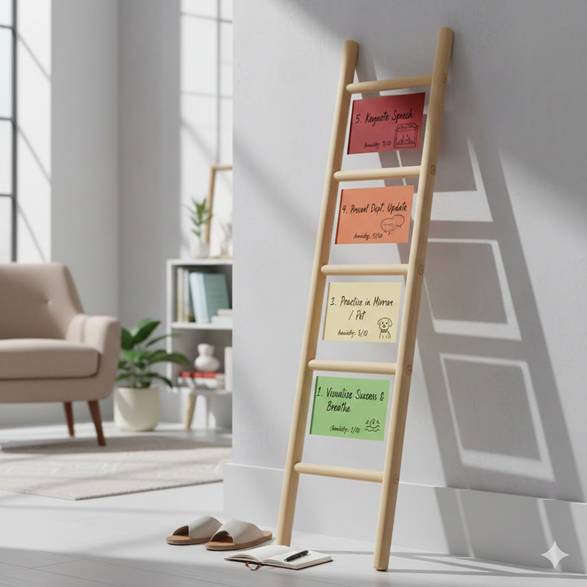
Your Anxiety Ladder: A Sample Hierarchy
You start at the bottom with activities that cause mild anxiety and only move up once you feel calm at that level.
- Low Intensity: Asking a brief question in a small meeting OR allowing a friend to take a candid photo of you while you are focused on a task.
- Moderate Intensity: Presenting a single slide to a small group OR taking a selfie alone to practice finding a neutral, comfortable facial expression without the pressure of an audience.
- Increasing Challenge: Volunteering for a committee OR participating in a group photo where you are buffered by others rather than being the sole subject.
- High Intensity: Giving a 10-minute presentation OR sitting for a formal professional headshot, using grounding techniques (like pressing your toes into the floor) to stay present.
A Work in Progress
The goal isn’t to be cured; the goal is to be functional and authentic despite the nerves. I still get nervous. My palms still get a little damp, and I still feel that instinctual urge to duck when a camera comes out.
But I have learned to be gracious and patient with myself. Practice slowly, confront the fear in manageable steps, and remember that your voice and your presence have value, whether it is heard from a podium or captured in a frame.
What are your fears, and how have you navigated around them?
Whether you are currently avoiding the stage, dodging the camera, or are ready to begin your own process of systematic desensitization, I am here to support you. Let’s work together to turn down the volume on that inner critic and expand your world, one small step at a time.


 Site Title
Leave a reply to Elicipha Njuguna Cancel reply